
Thursday, 9 December 2010

W.C.Fields Stamps 15c

The 15-cent W.C. Fields commemorative stamp was first placed on sale at
Beverly Hills, California, on January 29, 1980. W.C. Fields (1880-1946) was an actor and comedian. The stamp was released on the 100th anniversary of his birth. Designed by Jim Sharpe, it was issued in sheets of fifty.
Reference:
Postal Bulletin (December 20, 1979).
George M.Cohan Stamp 15c

The 15-cent George M. Cohan (1878-1942) stamp was first available on July 3, 1978, at Providence, Rhode Island. Jim Sharpe designed the stamp. Cohan, born in Providence, was a very versatile vaudeville performer. He is remembered for his talents not only as a singer and dancer but also as a producer, director, playwright, and songwriter.
USD 0.30
US Bicentennial 13c

American Bicentennial Issue: Washington at Princeton
On January 3, 1977, the United State Postal Service issued the 13-cent multicolored Washington at Princeton (Scott 1704) stamp to honor the 200th anniversary of George Washington’s victory over the British forces at Princeton, New Jersey. Designed by Bradbury Thompson and based on Charles Willson Peale's painting “George Washington at Princeton,” the stamp depicts Washington, Nassau Hall, Hessian prisoners, and a thirteen-star flag.
The multicolored stamp was printed on the Bureau of Engraving and Printing seven-color Andreotti gravure press (601) as sheets of 160 subjects, tagged, perforated 11, and distributed as panes of forty (eight across, five down). Mr. Zip, “MAIL EARLY IN THE DAY,” electric eye markings, and five plate numbers, one in each color used to print the sheet, are printed in the selvage.
At year’s end in 1776, Washington planned to strike the British forces in New Jersey. On December 30 he again led his forces across the Delaware River from Pennsylvania and into British-held territory in New Jersey.
When word of the American victory at Trenton reached Brig. Gen. William Howe, the British commander dispatched Lord Charles Cornwallis to the Delaware in search of Washington’s army. There Cornwallis met another British force already in the area. Arriving in Princeton on January 1, Cornwallis left a rear guard of 1,200 men under Lt. Col. Charles Mawhood and proceeded south toward Trenton with 5,500 soldiers.
During the night and into the early hours of January 3, Washington left 400 men in the camp to stoke bonfires and make digging noises while the bulk of the force silently departed, made a wide arc around Cornwallis’s sleeping army, and headed north toward Princeton. At daybreak, Lt. Col. Mawhood left a small force behind in Princeton and proceeded south to join Cornwallis, encountering American forces under Brig. Gen. Hugh Mercer. Washington, who was with the main force advancing on Princeton, heard the exchanges and rode to the battle. Limited fighting occurred within Princeton itself. Gen. John Sullivan and his men followed a small British force that sought refuge in Nassau Hall, the principal building of the College of New Jersey (later Princeton University). The British soldiers surrendered. The Battle of Princeton resulted in eight-six British casualties and around two hundred soldiers captured. The Americans suffered forty casualties, including Mercer.
On January 18, 1779, the Supreme Executive Council of Pennsylvania passed a resolution commissioning a portrait of George Washington for the Council Chamber and selected Charles Willson Peale as the artist. The original portrait is now in the Pennsylvania Academy of Fine Arts. Peale completed numerous copies for royal palaces abroad, each time updating the general's military dress. It has been suggested that this portrait was commissioned upon the order of Mrs. Washington because it is the only portrait in which Washington wears his state sword and because the painting descended in the Washington family.
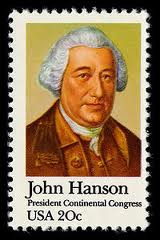
John Hanson 20c
USD 0.30
A 20-cent commemorative stamp honoring John Hanson, the American Revolutionary patriot from Maryland, was issued November 5, 1981, in Frederick, Maryland. The stamp designer was Ron Adair of Dallas, Texas, and the modeler was Clarence Holbert.
John Hanson was the first president of the Continental Congress under the Articles of Confederation. He was elected on November 5, 1781, and thus is regarded by some as the "first president of the United States." However, the office of president of the United States was not officially created until the US Constitution was adopted, so Hanson was president of the Continental Congress and not the chief executive of the United States.
Hanson served one year as the "President of the United States in Congress Assembled." Under his administration, peace terms were initiated, treaties were negotiated, and government departments were organized.
The stamp was printed in the photogravure process, with fifty stamps per pane.
George Washingston Stamp 20c
Washington, recent issues

Occurrences of Washington on US Postage stamps in recent times is much less than what it was in the 19th century and early 20th century. In the beginning of postage stamp issuance new issues were few and only presidents were found on US Postage, with the well liked exception of Ben Franklin. In recent days, issues are many and a whole array of various individuals are now found on US Postage stamps. The Post Office has been both admired and criticized for this practice.
Wednesday, 8 December 2010
The Martin Luther King Jr Stamp 15c
 USD 0.30
 The Martin Luther King, Jr. Holiday Bill

Clipping from unidentified newspaper or magazine describing the issuance of the Martin Luther King, Jr. U.S. postage stamp.
Timeline
April 4, 1968 – Martin Luther King, Jr. is assassinated in Memphis, TN.
April 8, 1968 – Congressman John Conyers, Jr. (D-MI) introduces legislation on the House floor to establish a federal holiday honoring Martin Luther King, Jr.
1971 – Congress receives more than six million signatures in support of the federal holiday, but no legislative action is taken.
1973-1979 – Several states enact statewide King holidays (IL, MA, CT, NJ).
1979 – CBC denounces amendment to commemorate the King holiday on a Sunday. Anything less than a full legal holiday is unacceptable.
November 1979 – Congressman Conyers' bill for a King holiday is defeated on the House floor by five votes.
January 15, 1981 – CBC supports a benefit concert, rally and march in Washington, D.C. to gain attention for the Holiday Bill. Stevie Wonder is the event sponsor, and his song "Happy Birthday" becomes an anthem for the movement.
August 1983 – Congresswoman Katie Hall (D-IN), CBC member and member of the House Post Office and Civil Service Committee, re-introduces the King Holiday legislation. It passes the House, 338-90.
October 1983 – The King Holiday Bill passes the Senate, 78-22.
November 1983 – President Ronald Reagan signs the bill into law (Public Law 98-399), declaring the third Monday in January as a federal holiday honoring Martin Luther King, Jr. and his service to this country.
January 20, 1986 – The first national celebration of the King holiday takes place.

Subscribe to:
Posts (Atom)